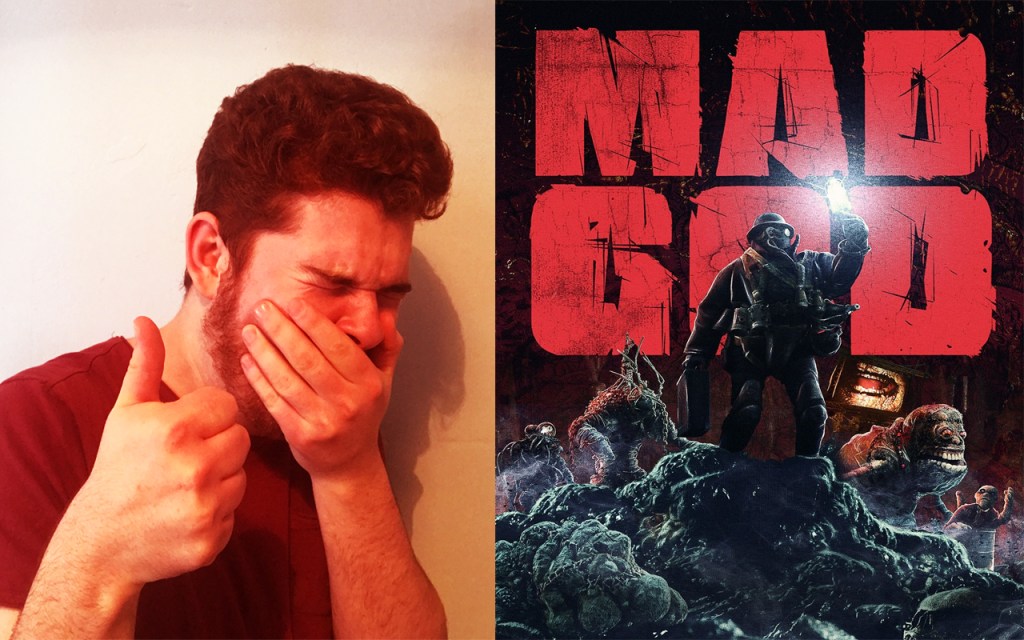
The first time you watch Mad God is the best. You may want to watch it again but probably not immediately after the first time. It’s one of those films where you have to be in a certain mood or headspace to want to see it, one you may not occupy often. I certainly don’t. Its use of stop motion is so exceptional and uncommon that the film may be a landmark in the technique. Mad God offers a decent balance of the ambiguity of an arthouse film and the spectacle of stop motion. It’s unlike anything you’ve seen.
This passion project 30 years in the making from stop motion master Phil Tippett depicts a mysterious assassin’s descent into an endless industrial hellscape, where living things are merely a material that can be destroyed and recycled in an instant.
The Plot
This is going to be tricky. Mad God is a true arthouse film in that it never fully explains how what you’re seeing is connected and what it means all together. There is no dialogue, you hear nothing but the sounds and noises of Mad God‘s world and the soundtrack that accompanies them.
Is it just a montage of creepy artsy imagery edited together in a random order? Absolutely not. There’s a narrative. We follow the assassin’s journey into the underworld as he encounters many strange creatures and machines. At one point we even get to see the assassin’s backstory and the world he comes from.
There’s plenty of industrial and religious imagery and on top of that, the film opens with a title crawl that quotes a few paragraphs from Leviticus Chapter 26. So like any good art film, Mad God is just specific enough in its storytelling for you to make a broad but rough interpretation.
The Animation
Mad God’s story will give viewers plenty to ponder over however there’s no denying that the film’s stop motion animation is the star of the show.
There are sequences so vast and complex from the number of puppets featured to the intricacy of the sets, that they’re actually some of the most stunning scenes made in stop motion I’ve ever seen. The world of Mad God really feels like a world. You’re never under the impression that this environment is restricted by tabletop space or set walls, it looks and feels endless.
All the creatures look like something from a nightmare. Most of them appear to be either deformed or artificial abominations stitched together with parts of other creatures. They’re clearly designed by a master craftsman of creature effects.
Without getting into spoilers, Mad God does feature some live action sequences with real human actors. I must confess that as much as I love the stop motion animation, I did not find its integration with the live action sequences convincing. You can clearly tell when the actors are on a life-sized set and when they’re green screened onto a stop motion one. The marriage with live action and stop motion can risk taking you out of the film but fortunately with the majority of the film being stop motion, even if you are taken out of it, Mad God should quickly regain your attention.
This should go without saying but Mad God is not for everyone. If you’re squeamish or not into arthouse films then don’t bother with Mad God. Any fans of Cronenberg or 80s’ horror will certainly appreciate the animation and creature designs, so I’d give them a light recommendation. However, I give a heavy recommendation to viewers who appreciate films that don’t give them all the answers and enjoy thinking and examining over what they see. They will certainly get a lot of Mad God.
I give Mad God a gloriously nightmarish 8 out of 10.
 Duffhood
Leave a comment