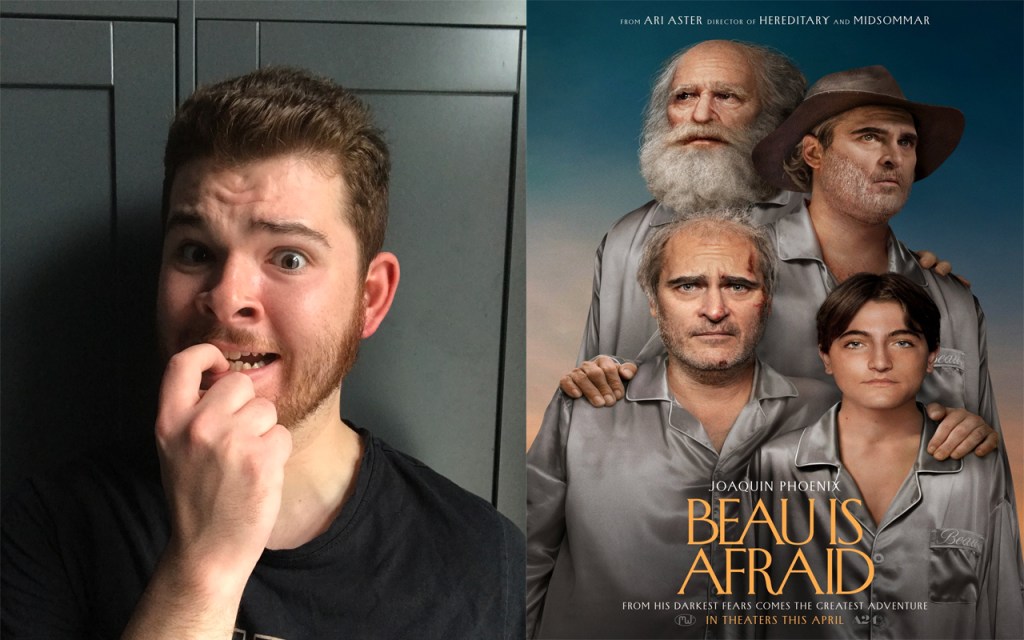
Of all the big abstract art films I’ve reviewed over the years, Beau Is Afraid is definitely one of the easiest to digest in that I can tell what subjects it’s tackling. What it says about those subjects is where the debate starts. I had to watch it twice to come to a concise take on it. I knew it couldn’t be argued that it was poorly made but I couldn’t decide whether it was good or bad. I have concluded that Beau Is Afraid is good but will be understandably frustrating for some.
When he learns that his mother has died, paranoid mentally ill recluse Beau (Joaquin Phoenix) embarks on a perilous odyssey to get home to his mother’s funeral. On the way he encounters many bizarre and intimidating characters. During this, Beau reflects on his relationship with his mother, including parts he’d rather not remember.
Beau
Of all the characters, Beau is the one we’re most certain of, which we eventually learn isn’t saying much. We get glimpses into his past and a good understanding of his mental well being. The same cannot be said for the other characters.
Many synopsises for the film describe Beau’s travels as an epic odyssey. In reality, Beau ends up visiting only two environments; the home of a married couple and a travelling theatre in the woods. Both feature many characters whose real intentions are opaque.
Beau however we know very well. Anyone who has experience with anxiety will immediately find him relatable. The city he lives in is crawling with madmen. His apartment is the only environment he can feel secure in. You feel for him when he realizes he must leave his safe haven but make no mistake, Beau is not merely a surrogate you can inhabit and view the narrative through.
The narrative concerns Beau in a deep and significant way. The flashbacks we get of his past are informative but clearly not showing the whole picture. If his relatability doesn’t keep you watching, his ambiguity will.
Beau presents as a sensitive, good-natured person but the way people react to him and the brief clips of his past make you question if he is who he appears to be. As the protagonist of a film that runs for exactly 2 hours and 59 minutes, he keeps you engaged.
What Does It All Mean?!
Beau Is Afraid gives you a good inkling of what it’s talking about. This is not the case with many big arthouse films of its kind, I’m Thinking Of Ending Things being a good example. Like those films however, it does not end with plain clarity.
Yes, it’s another one of those where it’s left to your interpretation but to the film’s credit, what it gives you to interpret is somewhat cohesive. Beau Is Afraid is not Inland Empire.
Many critics have concluded that the film deals with anxiety, paranoia, child abuse and motherhood. I agree. Without giving anything away, my stance on Beau Is Afraid is that it’s about the consequences of living for others and the fear of persecution, ideas that I think many of us can relate to.
If a 3-hour film with abstract elements and an ambiguous ending sounds like a bad time at the movies, you probably don’t need to be told to avoid Beau Is Afraid. If it sounds like a good time at the movies, you don’t need to be told to see Beau Is Afraid. If you’re a little in the middle however, I say give it a try. It’s beautifully made and even has a few laughs.
My opinion will undoubtedly change when I watch it again but for now, at this moment, after a couple of viewings, I give Beau Is Afraid a fine 9 out of 10.
 Duffhood
Leave a comment