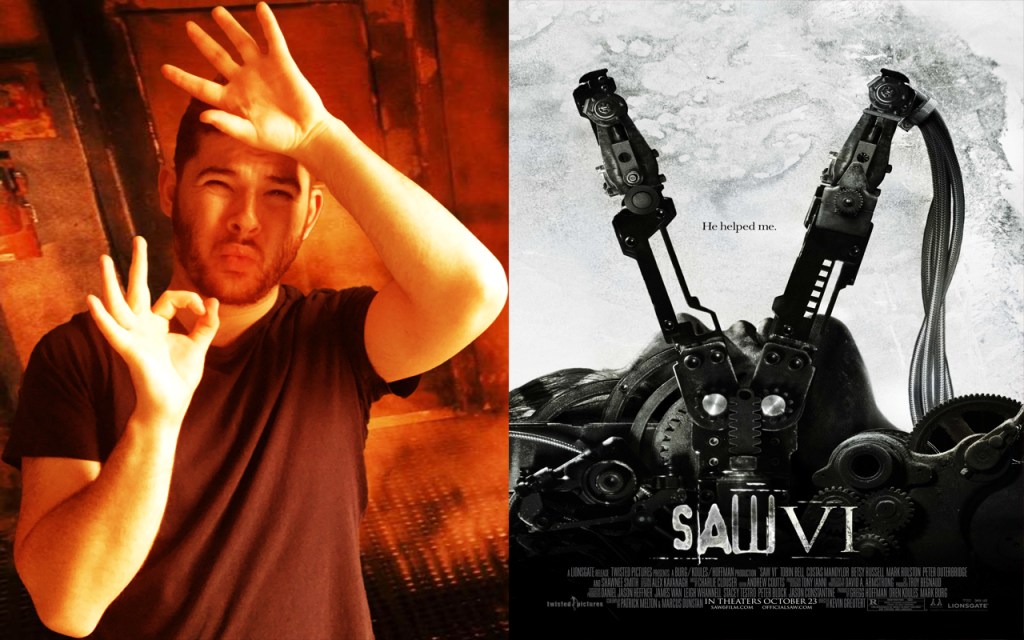
Saw VI achieves the impossible by not only interweaving two plots successfully but also making sense of Saw III, IV and V. The two plots that run through the film are equally compelling and relevant to each other. In an ideal world, this would be the real Saw IV. It’s annoying that you have to sit through two pointless entries to get to this point but it’s still nice to see, especially after the abysmal Saw V.
Mark Hoffman (Costas Mandylor) initiates the final game laid out by John Kramer (Tobin Bell), seeming to have successfully framed Agent Strahm for the Jigsaw murders. The subjects in this game are all employees of a health insurance company that refused to cover John’s cancer treatments. Among them is William Easton (Peter Outerbridge), the senior vice president of the company. As he progresses through Jigsaw’s ultimate test, Hoffman learns that his framing of Strahm may not have been as successful as he thought.
The Characters
Not since the original has a Saw film been seemingly certain of the time it takes place in. There’s a gazillion flashbacks but there’s no doubt that everything we see in the present is in the present. There’s no big twist at the end revealing that one of the subplots happened days before the other. Saw VI takes place in the time following John Kramer’s autopsy in the opening of Saw IV, the entirety of Saw V taking place beforehand. Hoffman’s colleagues, special agent Erikson (Mark Rolston) and agent Perez (Athena Karkanis), who is alive to Hoffman’s surprise, suspect that Agent Strahm was framed and take steps to identify the real perpetrator.
Saw VI has a cat-mouse thriller plot similar to that in Saw V but executed much better. Hoffman is the mouse to the FBI’s cat and unlike Strahm, we’re interested in how he does. If there’s one thing Saw V did right it was getting us invested in Hoffman. I’m not saying he’s a well-written character but like John Kramer, he can hold your attention. As well as being cunning and charismatic, he has the difficulty of investigating his own murders while avoiding exposure.
Like Strahm, Hoffman doesn’t know what his hunters have up their sleeves but since we know him and know that he’s got a lot to lose if he gets caught, his story is very engaging.
The same can be said for the plot concerning William. He’s not a monster like the subjects in Saw IV or V but more of a ‘lawful neutral’ using D&D alignment terms. While working at his health insurance company, William devised a formula that provided coverage for claimants less likely to become ill while denying it to those in need. He does not see himself as the ruthless gatekeeper of life that Jigsaw does but as a businessman who merely desires clients who’ll be financially convenient.
If you haven’t guessed, Saw VI offers a blatant commentary on the American healthcare system but fortunately, it doesn’t feel forced or out of place as it has been established that the series takes place in an impoverished American city where careless elites like William would exist.
His ethics are despicable but are his tests fun to watch? Of course not. We understand Jigsaw’s philosophy better now than we did in the first film but however loathsome his targets are, they are human beings who are flawed and have made mistakes. This is what undoubtedly makes Saw VI one of the good sequels, its grassroots premise of a questionable individual having to suffer to validate the decisions he’s made in his life.
The Horror
While the writing is solid, the execution is just as generic as previous entries. At this point in the series, the Saw formula has been perfected and done to death. Every film starts with a prisoner dying in a trap and ends with Hello Zepp playing over a big twist. Every film relies almost entirely on gore to elicit fear. Saw VI is no different. It does have a couple of jump scares to its credit but they still don’t make up for the lack of creativity.
The only highlight occurs towards the end where William discovers six of his colleagues chained to a carousel trap. The scene is supposed to be taken seriously but there’s a voice in your head that can’t help but whisper “A carousel trap? Wow. We’ve really come a long way.”
It doesn’t ruin the film or kill the tone but I can totally imagine audiences watching back in 2009 thinking the series had jumped the shark, and maybe they were right.
Saw VI is another one of those horrors where everything but the horror is interesting, which is not a rare occurrence but in this context, with two uninspired predecessors to consider, it’s worth noting. I wrote at the end of my Saw V review that I hoped Saw VI or VII would do a better job. I’m happy that one of them did.
I give Saw VI a worthy 7 out of 10.
 Duffhood
Leave a comment