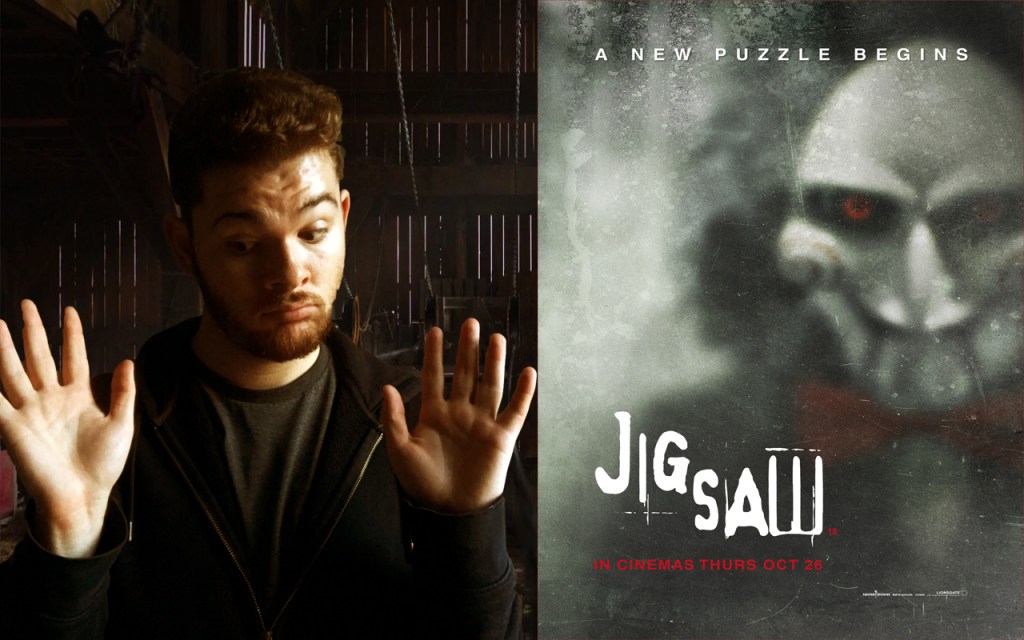
Jigsaw does not give itself an easy job. It ventures to be a Saw film without John Kramer, which is like a Texas Chainsaw Massacre without Leatherface. It introduces completely new characters with no relation to Kramer or any of the cast we’re familiar with, these characters have to be interesting on their own. Despite some overindulgent references and generic characters, Jigsaw performs quite well within its restrictions, telling a genuinely intriguing murder mystery.
Five strangers are locked in a barn and forced to partake in a series of grizzly games. The police hunt for the party responsible yet all the evidence they collect points at a killer who has been dead for 10 years.
The Characters
Jigsaw is quite a typical Saw sequel in that its police plot is more interesting than its prisoner plot. I say it’s quite a typical sequel because the prisoner plot set in the barn isn’t that bad honestly, it’s just a tad less compelling than what the cops get up to. It does prevent Jigsaw from descending to the pits of Saw V and 3D as what happens in the barn does become relevant to the police and their investigation.
Speaking of which, four characters lead the police plot and like the prisoners’ plot, it’s an ensemble piece as all of the cast receive equal time and attention. What makes their plot more engaging than the prisoners’ however is the indication that one of the quartet is the killer.
The quartet consists of two detectives and two pathologists. The writing behind them is pretty strong because with each story beat comes new information about them that either strengthens or weakens their status as a suspect. There are few moments where you’re not on your toes about at least one of the quartet. Honestly, out of all the Saw films I’ve seen so far, Jigsaw implements the police-procedural genre the best.
The barn scenes are very grassroots Saw. Like in the original film, every test the prisoners encounter forces them to reveal a secret that alters our perception of them. For some, the revelations are not surprising like like Ryan’s (Paul Bernstein), for others however they are devastating, Anna’s (Laura Vandervoort) being the best example.
They’re certainly not the most likeable or interesting group of prisoners we’ve encountered but what the traps force them to do and where they take them you will not anticipate.
The twist at the end while very surprising, links itself to the events of the previous films in an annoyingly generic fashion but to its credit, it makes sense and you won’t see it coming.
The Horror
When it comes to horror, Jigsaw is a mixed bag. There are scenes where the film proves to be a typical Saw sequel with an overreliance on gore, just with better-looking and more anatomically accurate effects. There are also scenes however where the film uses suspense, the anticipation of gore or injury, similarly to the reverse bear-trap scene in the first film.
These sequences all take place in the barn obviously and are very effective. The best example concerns Ryan and is prolonged for several scenes, giving you plenty of time to put yourself in his position and contemplate whether you could do the thing he has to do.
It’s a masterpiece compared to Saw 3D and while the gore, characters and stupid twist at the end sets it far from the likes of III, VI and the original, its police procedural aspects and usage of suspense indicate that the film is aiming for something higher than a typical Saw sequel, which deserves credit.
I give Jigsaw an average 7 out of 10.
 Duffhood
Leave a comment