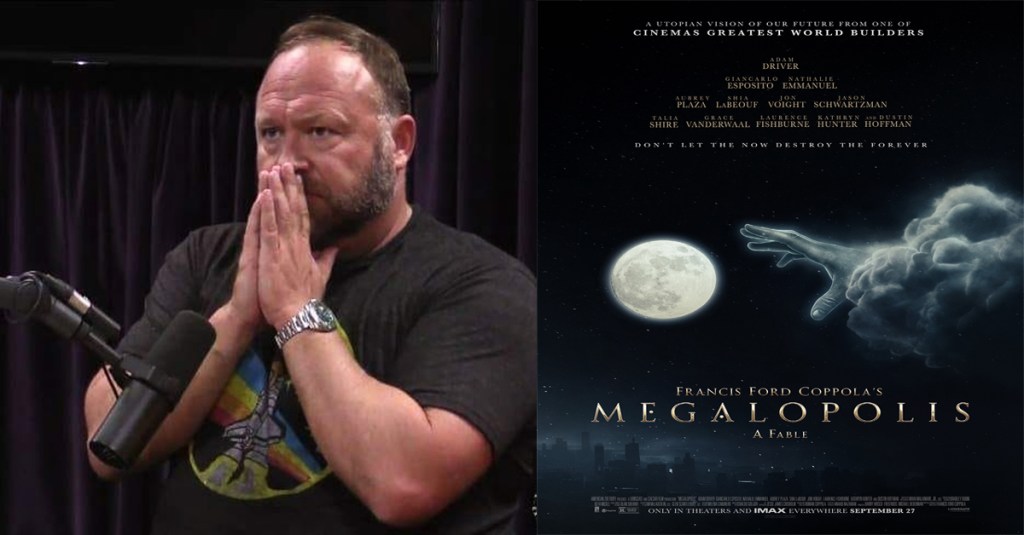
Robert Mckee wrote that the love of a good story is not enough, ‘good story’ means a good story ‘well told.’
I think there is a story in Megalopolis worth telling, in fact I think it just might have something ‘the world wants to hear.’ However, it can be argued that the story of Megalopolis is terribly told.
Pretentious dialogue, numerous plot holes, artsy-fartsy edits; the film is undoubtedly a difficult watch but, after two viewings, I now have some appreciation for the story Megalopolis was trying to tell.
This is another one that’s so crazy and all over the place that I’m not going to bother breaking it down. I’m just going to write from my gut.
Megalopolis concerns the mission of architect Cesar Catilina (Adam Driver) to establish an utopian city in 21st century New Rome. He intends to build this city out of Megalon, a miraculous resource he created that earned him a Nobel prize. He also has the ability to stop time. How he can do this or how he created Megalon is never explained.
Many stand in his way. Like old Rome, New Rome is dominated by patrician families, one of which Cesar is apart. He has an uncle, Hamilton (Jon Voight), who’s the head of a national bank and a cousin, Clodio (Shia LaBeouf), who lusts for power.
As a character Cesar has his flaws; he’s bereaved, addicted to drugs and his cold intellectual demeanour makes him socially unattractive. However, these personal flaws don’t infect his vision of Megalopolis. A bulk of the plot chronicles the efforts of New Rome’s Mayor Cicero (Giancarlo Esposito) and Cesar’s relatives to stop his city from being built.
Both factions reflect liberal and conservative values; the mayor fears Megalopolis will generate more inequality while Hamiliton and Clodio fear it will threaten their wealth and influence.
If there’re any scenes where Cesar’s idea for Megalopolis is shown to be wrong or unethical, I didn’t notice them. Not in my two viewings. No legitimate counter argument against such a city is made.
Comparisons to the works of Ayn Rand are warranted because, in my interpretation, the film is in favour of Cesar’s utopian vision.
The collusions made against Cesar are based on the Catilinarian conspiracy of 63 BC. If you don’t know what that is don’t worry, neither did I. This inspiration is blatant in character’s names and particularly the look of New Rome. Like Lynch’s Dune, Megalopolis boasts a wonderful blend of ancient and modern cultures. There are guns, cars and satellites but there’re also togas, Colosseums and beautiful statues. If there’s one area where the film succeeds in realising its ambition, it’s in the production design.
Cicero, Hamilton and Clodio’s activities are frankly more entertaining than any of Cesar’s. His scenes are where most of the pretentious dialogue and abstract visuals occur. If Cesar’s arc encourages anything beyond surrendering the future to innovators and scientists, it went over my head.
The film takes place in New Rome yet people use dollar bills, display the American flag and the Soviet Union exists. If there are legitimate reasons for these choices, they either weren’t explained or went over my head.
Megalopolis asks the big questions of how to achieve an ideal society and who should be allowed to build it. The film does a decent job of representing the debates that would occur across the political spectrum, however the answer to its questions stares us in the face within the first few minutes; Cesar.
I can definitely see Megalopolis aging well visually. Will it be seen as a masterpiece after a few generations? I don’t know. Right now I can’t see how but if the day should come, I’m open to being proven wrong (if I’m still around then).
I hope my mind will change in a few years’ time because if it doesn’t, then Megalopolis may become a true failure.
Its ambition is deserving of a full 10 out of 10 but its overall execution gets a 6 from me (for now).
 Duffhood
Leave a comment