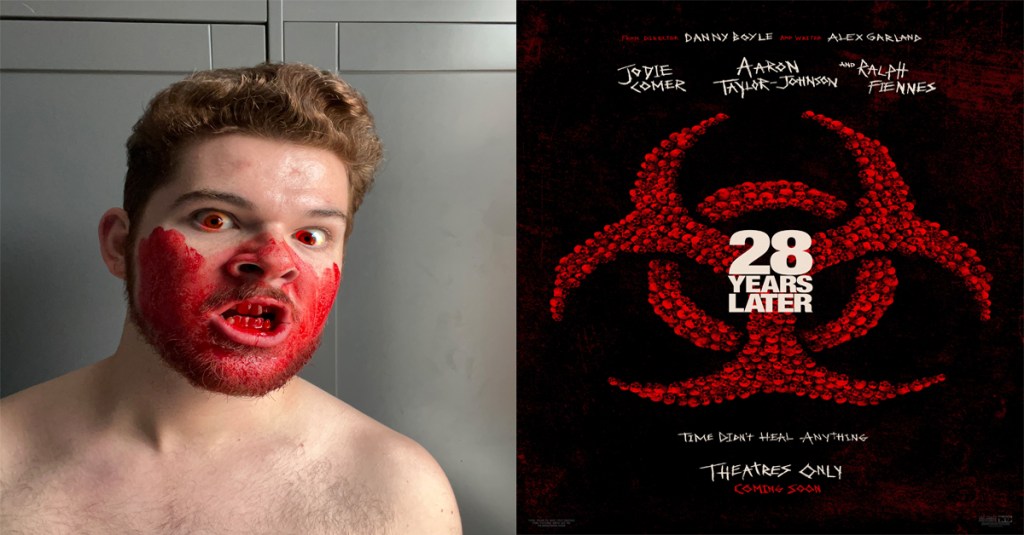
I can’t see anyone genuinely hating 28 Years Later, but I can imagine a few feeling alienated by it. Its style of filmmaking can be very guerrilla and experimental. Additionally, its vision of a zombie-laden Britain can be a little derivative of shows like The Last of Us. Its writing however is impeccable, making for undoubtedly the most emotional and engaging entry in the 28 series.
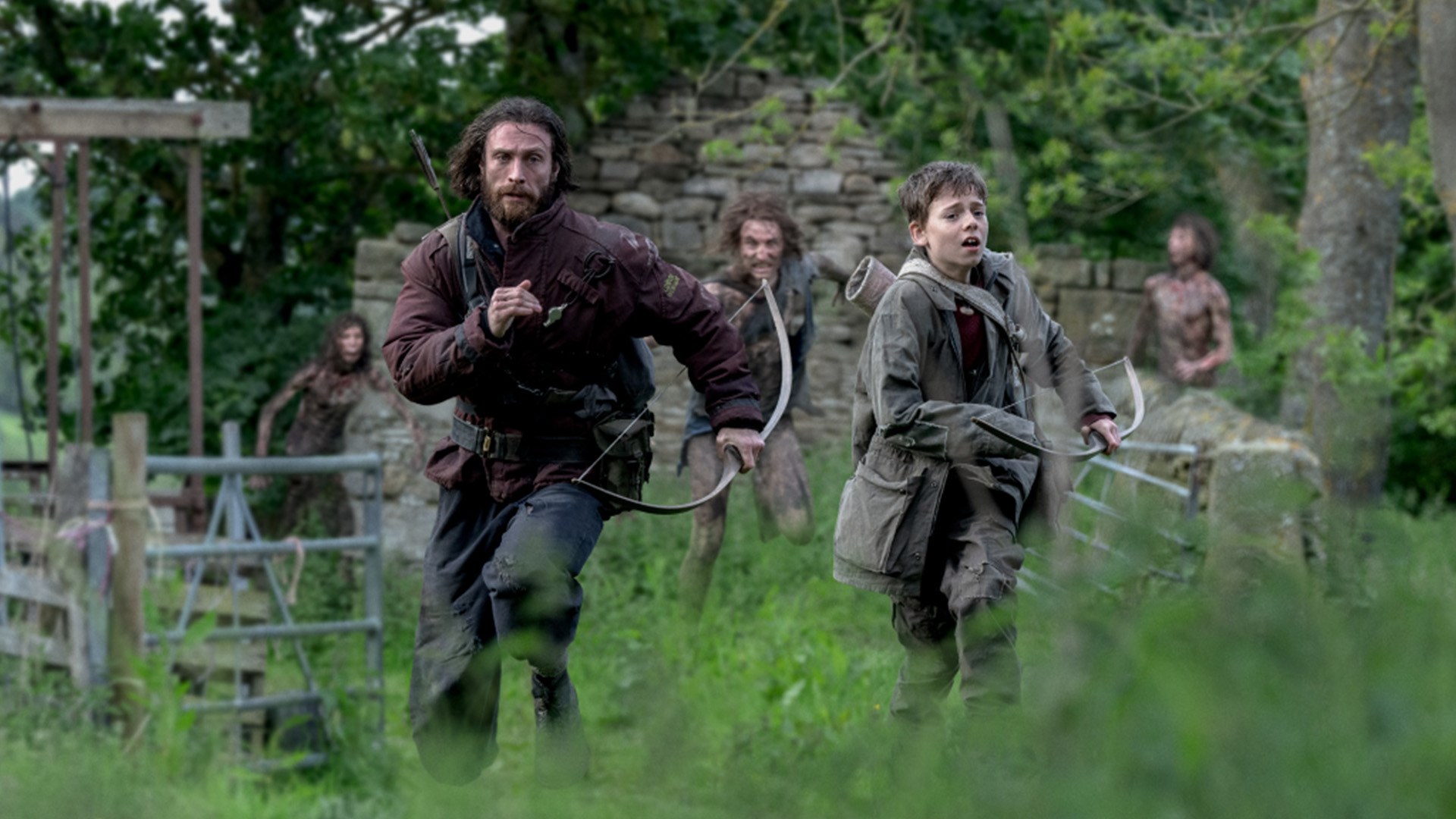
Almost three decades after the initial outbreak, the rage virus has been driven back from continental Europe and quarantined within the British Isles. Spike is a 12-year-old boy who lives in a village on an island, which connects to the mainland via a causeway. His mother (Jodie Comer) is suffering from an unknown illness. When he hears about a doctor (Ralph Fiennes) living on the mainland, Spike abandons his father Jamie (Aaron Taylor-Johnson) and brings his mother across the causeway, determined to cure her.
The Characters
As much as I loved 28 Weeks Later, I’ll admit that the characters did not have the personality and charm of 28 Days Later’s cast.
Anyone who preferred the original over its 2007 follow-up will be overjoyed with the characters of 28 Years. Right off the bat, Spike is hard not to like. He’s at an age where he still retains a high degree of innocence. He’s also approaching an age where he has to learn to defend himself, which fuels some conflict between him and his father. Make no mistake, Spike’s father is not a bully or a tyrant. Jamie conveys unconditional love for his son numerous times, however tension arises when Spike proposes finding the doctor on the mainland to treat his mother.
Jamie and the other villagers hold purist views about staying alive and avoiding those who don’t share their traditional values, this doctor being a prime example. Jamie maintains this position even though it will inevitably lead to his wife’s death. This makes for great drama, better and more visceral than the family drama in Weeks or the ethical dilemmas in Days.
The doctor character, portrayed by Ralph Fiennes, is nothing like what you’re led to expect. Through him, we are presented with themes regarding the inevitability of death. The film is not subtle in this area. Mark Kermode is right to say that 28 Years has no subtext, just text. The film blatantly tackles how isolationism can affect our families, our relationships and our understanding of the world at large. Like I said, it’s not subtle, but in an age where people’s intentions are almost impossible to guess, perhaps a bash on the head is what we need.
The Worldbuilding
I don’t want to sound like a ‘woke SJW’, but as someone based in the North East of England, it’s wonderful to see our fine region presented on the big screen. Landmarks such as the Angel of the North stand in oceans of overgrown vegetation. This English countryside has devolved into a jungle with no civilisation to tend to its forests and fields.
28 Years’ rural setting will make it stand out amongst its genre counterparts. Had it returned to London, 28 Years would have been at risk of looking like dozens of other doomsday films.

Early on, we learn that the rage virus has mutated over the years, producing different variants of zombie. One breed travels on all fours and feeds on soil and worms. The most prevalent variant in the film is the ‘Alpha,’ a large, muscular infected that leads other infected like the alpha of a pack.
I was pretty hard on 28 Days Later when I covered it in 2015. It’s one of the few blog posts of mine that continues to get reads to this day. I must confess that I have mellowed towards it over the years so with that in mind, I can’t say I’m onboard with the idea of there being variants of the infected.
Different zombie breeds are a relatively new idea, especially in film and TV. However, it’s been a common trope in video games for the last 15 years, Left 4 Dead and Days Gone being good examples. The Last of Us was brought to the small screen in 2023 and while I know that’s very recent, I can’t help but feel that 28 Years is following the crowd. My stance may change, as it did with 28 Days, but I was hoping that a series lauded for being a trendsetter would be more original.
Some of the gore is also a little cartoony for my liking, and I know how that sounds coming from a defender of 28 Weeks Later, which features a chopper slicing up a horde of zombies with its propellers.
Perhaps 28 Years will grow on me after a few rewatches but as I said before, the writing is impeccable. If I had to rank it against the other two, I’d place 28 Years at number one, Weeks at two and Days at three.
Needless to say, I cannot wait for The Bone Temple.
I give 28 Years Later a blood-stained 8 out of 10.
 Duffhood
Leave a comment