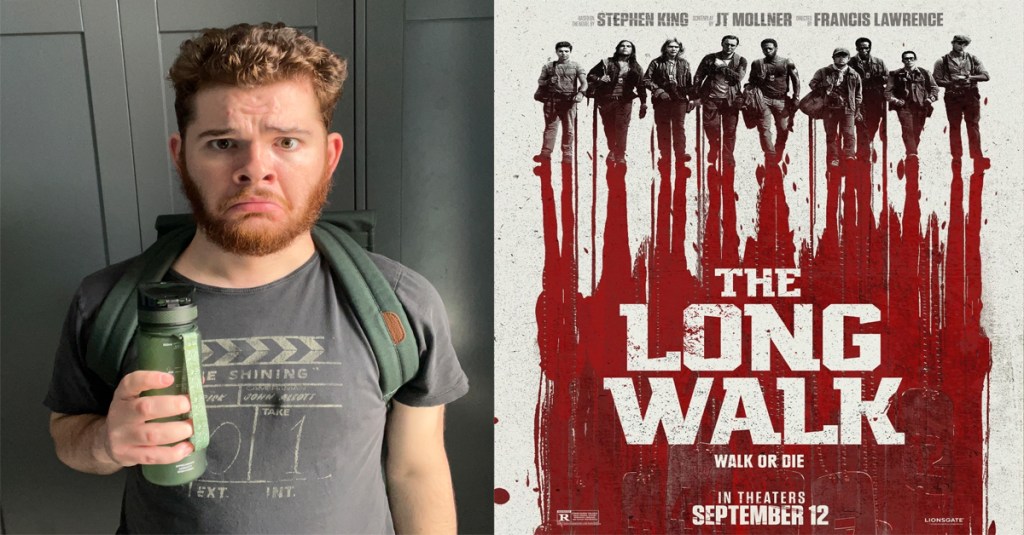
The Long Walk delivers so much more than its alluring premise teases. The marketing campaign has done the film no favours, presenting it as a Shyamalan-style horror thriller. It is anything but. The Long Walk is a moving drama set in a dystopian America that tackles nationalism, oppression, war, poverty, friendship and masculinity. This could very well make it into my top 5 best films of the year, it’s that good.
Fifty young men are selected by lottery to participate in a lethal competition, where everyone must walk continuously until one contestant remains. Anyone who doesn’t keep pace is shot dead by one of the military escorts.
The Characters
Most of the players receive an equal amount of development, however Raymond (Cooper Hoffman) is the one we get to know best. He’s our surrogate in the story but we can’t be sure that he’s our protagonist.
He could be taken out at any second, just like the other contestants. The writing does a great job of allocating a fair amount of time to each character, establishing their background and goals. This does wonders for the tension as you’re never sure of who will be the last one walking.
With a setup reminiscent of Battle Royale and The Hunger Games, moments of cutthroat aggression are expected. While The Long Walk does fulfil this expectation, what makes the film stand out is Pete (David Jonsson).
He is a real surprise. He’s like Mr Rogers; he has no interest in winning, he’s prepared to die, he wants nothing but the best for all the other players and is happy to be everyone’s friend. With his open and loving persona, the walkers relax their vigilance, allowing their humanity to emerge.
Even the contestants who deflect Pete’s positivity later become more than they appear. Gary (Charlie Plummer) is a great example of this. Initially, he is the bully of the troop. He remembers what everyone else forgets when around Pete; only one of them is going to live. Gary embraces this fact and intends to win, but after seeing many players die, his hard, competitive exterior begins to crumble.
Leading their military escort is the Major (Mark Hamill). He is the country’s dystopian ideology made flesh. He lectures the players, encouraging them, saying that “anyone” can win. He reminds them that the Long Walk is part of America’s economic and spiritual recovery. Make no mistake though, he’s not another shouty drill sergeant. Just like Gary, he turns out to be more than he appears.
The film could be about what it means to be a man, what it means to be poor, what it means to live in Trump’s America or a variety of other themes. A case can be made for all of them but the film’s ability to invoke pathos is blatant.
The Worldbuilding
To me, The Long Walk feels like a good episode of Doctor Who or Star Trek. It talks about big ideas in a restricted setting.
For most of the film, all we see is a single road snaking through various small towns and rural landscapes. Yet the world the characters describe concerns the entirety of the United States, a devastating war, an economic depression and an Orwellian dictatorship. The dialogue among the contestants does a lot of heavy lifting here, which is appropriate as the film is about how its world affects individuals, not collectives.
The Long Walk is not a horror film, hence it’s annoying to see the marketing present it as one. It shouldn’t be included in the horror renaissance we’re seeing this decade. The film should be considered as an intimate dystopian drama, similar to It Comes At Night and The Road.
It may not make a scene at the box office, but it absolutely deserves a rediscovery when it hits streaming. I can’t praise this film enough. I can only encourage everyone to see it while it’s still showing.
I give The Long Walk an outstanding 10 out of 10.
 Duffhood
Leave a comment