
Del Toro and Co. have done it again with another adaptation of a classic that is similar enough to the source material to be recognised, but different enough to justify its own existence. Not everyone will like it; it’s not a jumpy horror or an elegant costume drama, but a poignant and existential saga.
Is it worth explaining the premise? Surely everyone knows it.
The Characters
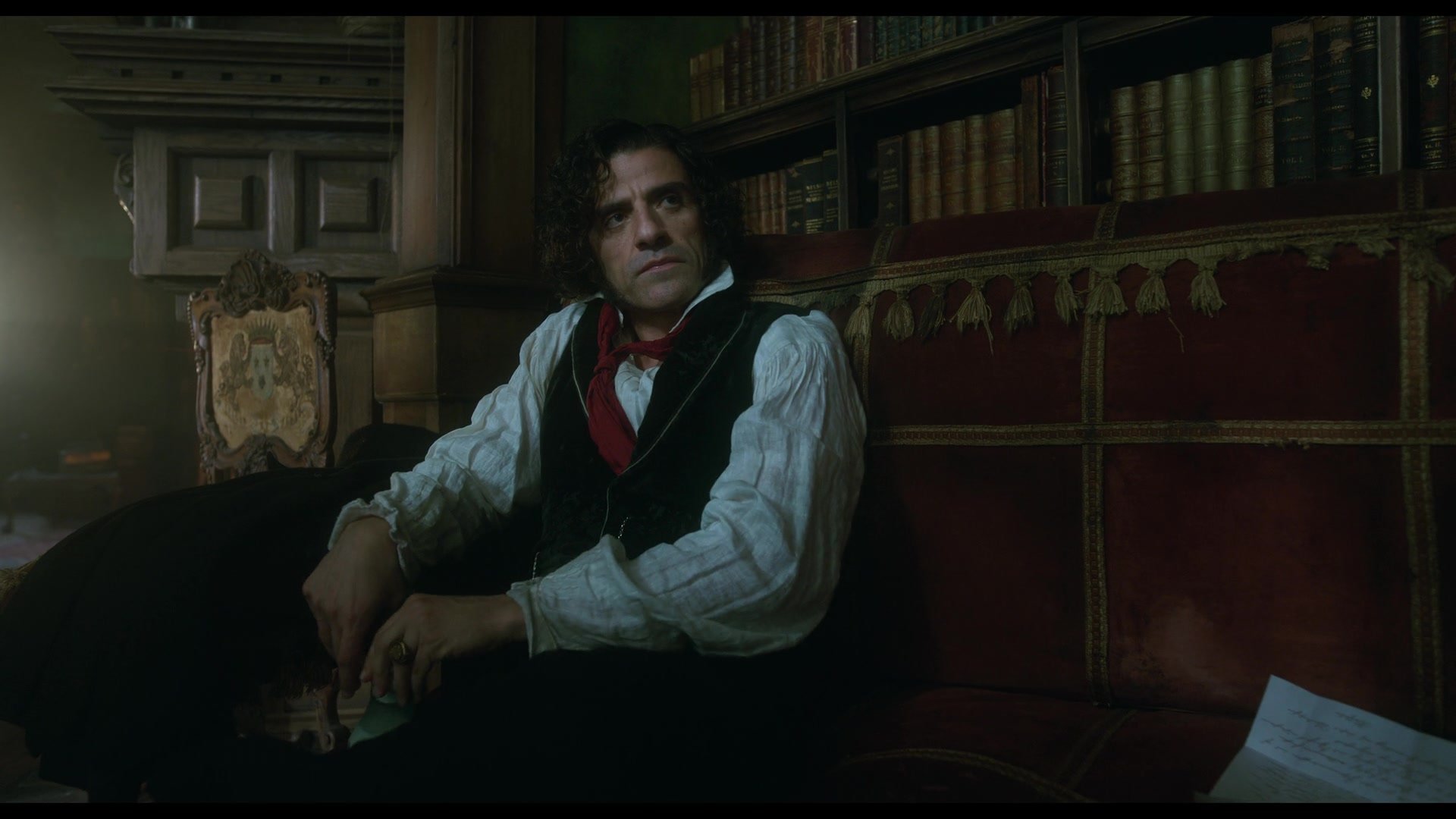
Victor Frankenstein (Oscar Isaac) is a magnificent antihero. His narcissism in adult life can be frustrating to witness, but having seen his childhood, you can’t say you don’t understand.
His father (Charles Dance) never really loved him, his younger brother (Felix Kammerer) was always the favourite. He adored his mother and was devastated when she died, hence he made it his mission to harness the essence of life and defeat death.
The love from his mother was the only thing in his life that Victor enjoyed. Everything else, from academia to medicine, is a pinnacle to conquer. Without love, Victor can only dive into his work, which feeds his narcissistic ambition. Like any good antihero, you may not like him, but you want to see where he goes.
Things take a turn when Victor meets Elizabeth (Mia Goth). In a big deviation from Shelley’s novel, she is the fiancée of Victor’s brother. Her engagement, combined with her sharp intellect, love of insects, and entrancing beauty, only makes her more desirable to Victor.
Then he creates the monster (Jacob Elordi), or ‘The Creature’ as he’s called in the credits. Like all of Del Toro’s monsters, there’s nothing wrong with him, but a lot with the world he’s born into. The creature is blatantly more sympathetic than Victor. He demonstrates intelligence and compassion, but in ways that don’t impress his maker.
The creature is eventually disowned and abandoned by Victor, forcing him to take refuge in the hovel of a farm. There, he meets an old blind man (David Bradley), who takes him in and teaches him to read and speak. Throughout his time on the farm, the creature experiences the same joy and loss that haunted his creator.
Like I said, not everyone will like this film. It’s not as plain as Kenneth Branagh’s version; it won’t nudge you to feel sad or happy for someone. For the most part, it presents the characters as they are with little judgment.
The Themes

While it covers many things, the Frankenstein story does have some core themes, of which Del Toro’s version includes. The dangers of the pursuit of knowledge, for example, are woven throughout as Victor’s ambition gradually shifts to regret as he sees the result of his scientific enterprise.
Death is a core theme as it is in the book. The sins of the father aspect emerges as Victor and his creation clash with each other.
And of course, the Prometheus influence rears its existential head as the film draws to a close. This is where Del Toro and Co. really leave their mark on Frankenstein. I won’t spoil anything, but all I’ll say is that Del Toro resolves the Frankenstein story in the most touching and hopeful way I’ve ever seen.
This will almost certainly earn a spot in my Top 5 Best Films of 2025 list. I think one of the reasons why Frankenstein is such an enduring horror story is that it’s sad. Most of us probably won’t face anything genuinely scary in our lives, but we all experience sadness and try to avoid it. Which is why the saga of Victor and his creation is more depressing than frightening, and this film chronicles that saga perfectly.
I give Frankenstein an outstanding 10 out of 10.
 Duffhood
Leave a comment