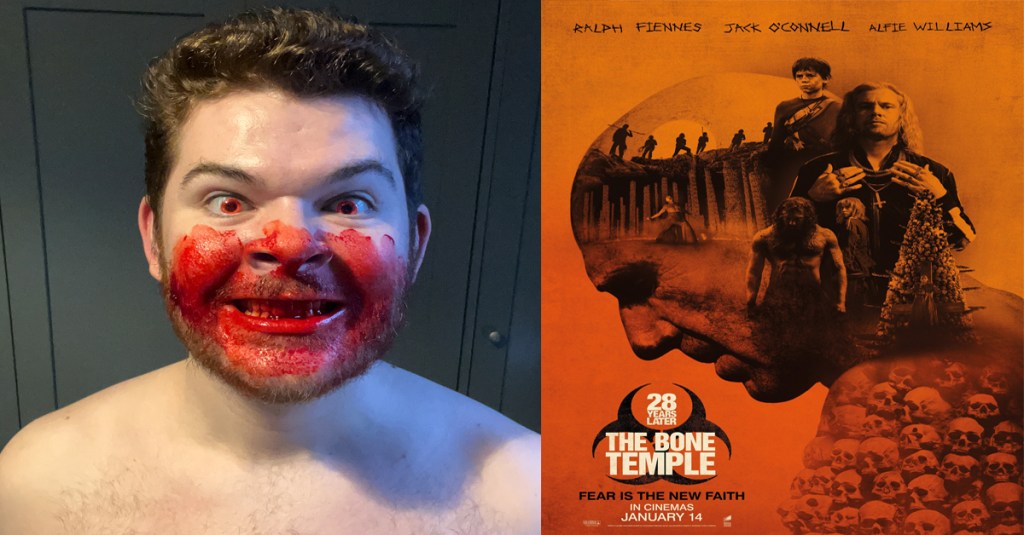
Anyone who walked out of 28 Years Later feeling a bit baffled will be delighted by The Bone Temple. Everything set up in the last film, the good and the bizarre, is fleshed out and paid off. The second act tends to be the best part of a play, and in this trilogy, The Bone Temple is no exception.
Against his will, Spike (Alfie Williams) has become a member of the Jimmys, a satanic cult that roams through mainland Britain, torturing whoever they encounter. Meanwhile, Doctor Kelson (Ralph Fiennes) makes a breakthrough in understanding the infection.
The Characters
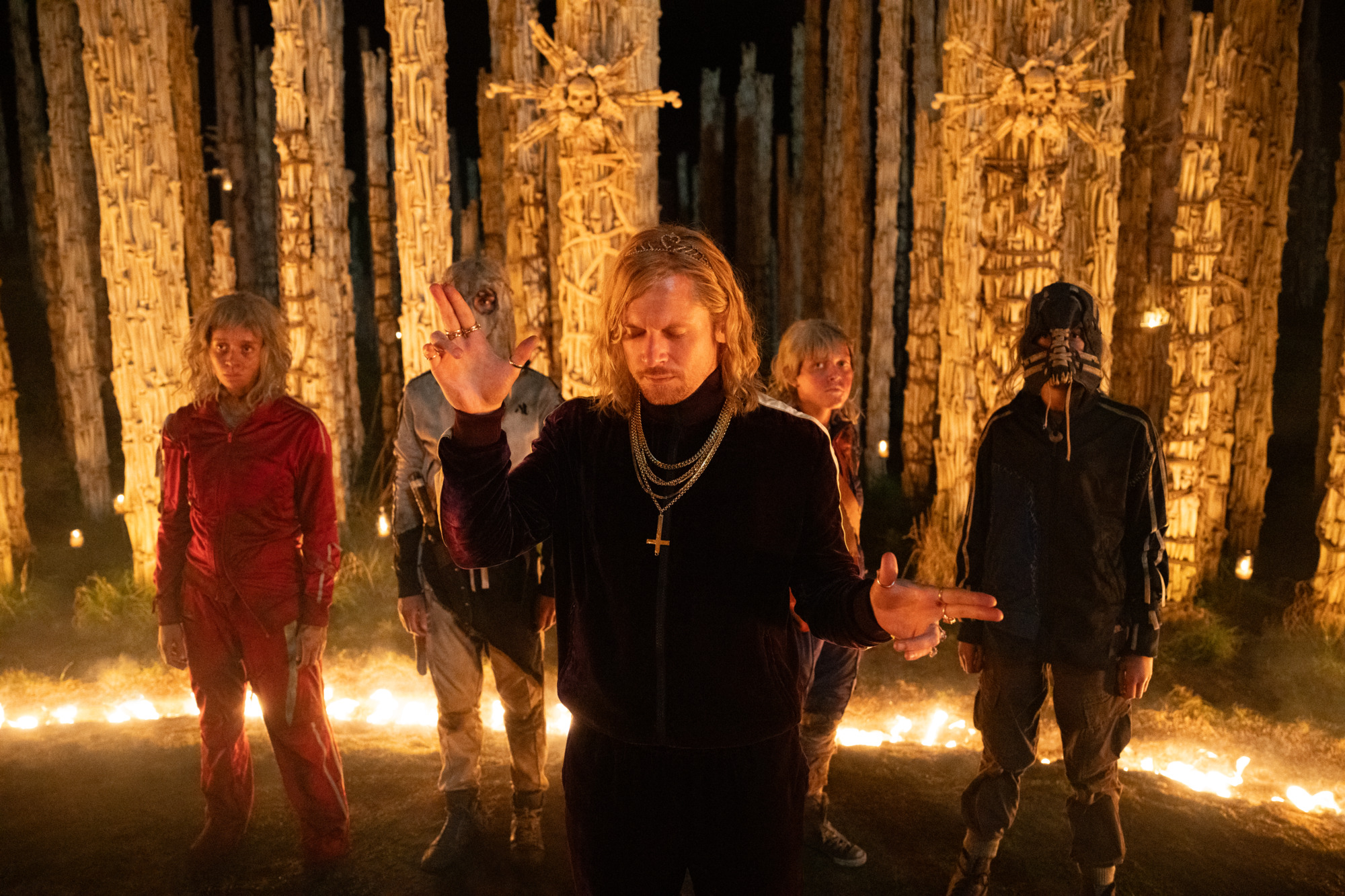
If you haven’t already heard, Jimmy Crystal (Jack O’Connell) steals the show. Imagine the sadism of Alex, from A Clockwork Orange, blended with the god complex of Immortan Joe, from Mad Max, clad in a wig and tracksuit, bearing a disturbing resemblance to a certain disc jockey.
The leader of the Jimmys is a villain for our times, a fanatical tyrant who exploits the faith and fears of his followers to achieve his brutal ends. Jimmy Crystal is almost the lead character in The Bone Temple as Spike is a lot less active in the plot than he was in the last film.
This comes as a big surprise, but as the film progresses, you come to realise that his passive role makes sense thematically. Just like in the last film, Spike is our surrogate. 28 Years Later was about him leaving his community and all the values and traditions he grew up with. The Bone Temple sees him trapped in a different community, one that lives on the road with no stronghold. One you join out of necessity, not choice.
Spike is forced to stay with the Jimmys and follow their ways. He witnesses, as we do, how people, when abandoned and unprotected, devolve into fundamentalism and perform unspeakable acts that go against their reason and better judgment. In the Jimmys, rebellion or desertion means death. All Spike can do is watch and learn, and all we can do is watch and learn with him.
Doctor Kelson is the yin to Jimmy Crystal’s yang. He’s an atheist and a man of science who uses his medical expertise to gain a deeper understanding of the infection. As a sequel, The Bone Temple absolutely delivers by giving us more of one of the last film’s best characters. We see Kelson in his element: alone, maintaining his monument and listening to music from his youth, which results in some strange and amusing dance sequences.
Towards the end of the second act, the Jimmys come across Kelson’s monument. Jimmy Crystal approaches Kelson on behalf of the gang and has a conversation with him. This is one of my favourite scenes; we learn a lot about Jimmy and how he became who he is, we see where he and Kelson disagree and where they’re willing to negotiate.
The characters and the writing are top-tier in The Bone Temple, anyone who was put off by 28 Years Later will be won over.
The Worldbuilding
In my review of the last film, I expressed concern with the introduction of different breeds of infected, like the Alphas. I thought it was too derivative. I was sad to see the 28 franchise following trends instead of setting them.
However, there is a shot, literally a single shot, in The Bone Temple that sold me on the idea.
It depicts Samson and his ‘pack’ eating the remains of a survivor; Samson sits on his own, eating the head, while the other infected feed on the body behind him. This shot perfectly encapsulates the natural hierarchy among the infected. If there were a similar shot in the last film, I would’ve been a lot more lenient on the issue.
Few zombie stories explain the scientific process of zombification; almost none explain what it would feel like to become a zombie.
Kelson performs numerous experiments on Samson, mostly by giving him opioids and antipsychotics. While the exact nature of the infection as a whole remains a mystery, The Bone Temple shows us the subjective experience of being infected, even showing a person’s POV when infected. By the climax, it’s suggested that Kelson may have found a cure for the infection. Where the story goes from there, I can’t even speculate.
The Bone Temple is a textbook, solid sequel; it builds on the mythology established in its predecessor, doesn’t retread old ground and introduces new concepts that progress the story. Once again, needless to say, I cannot wait for part three.
I give 28 Years Later: The Bone Temple an outstanding 9 out of 10.
 Duffhood
Leave a comment