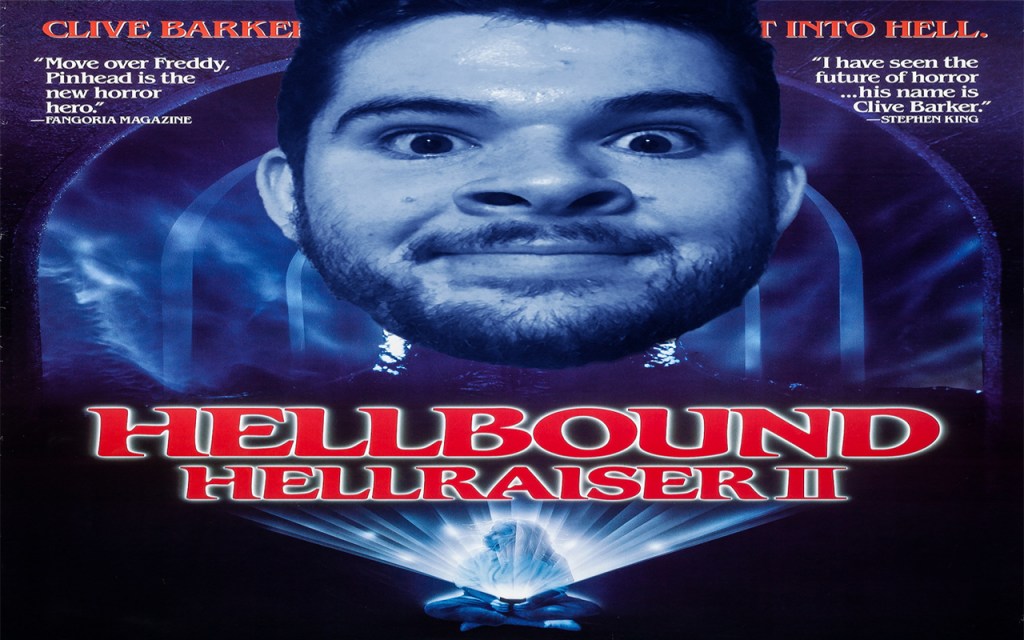
It’s subpar next to the original, the characters aren’t as well written, the plot holes are unforgivable but with its great effects, expansion of the first film’s mythology and abundance of messed-up ideas, Hellbound: Hellraiser II is a lot of fun.
Kirsty is put in a psychiatric hospital following the events of the first film. She receives a nightmarish plea for help from her deceased father who is trapped in hell. Kirsty befriends a mute patient called Tiffany and together they follow Doctor Channard, the head of the hospital, as he uses a lament configuration to embark on a journey to the cenobite dimension.
The Characters
I remember watching Siskel and Ebert’s review of Hellbound when I was a teenager. I recall Roger Ebert explaining how basically all the scenes can be put in any order and create the same result. I believe Ebert has a point as Hellbound’s plot has a lot of potential setups but very few of them are paid off. This is due in part to the way the characters are written.
Kirsty is slightly more engaging than she is in the first film as she has a lot more to do. She’s on a perilous quest to retrieve her father from the ducts of hell. However, without getting spoilers, her quest comes to a rather abrupt end about half-way through the film, leaving her with nothing to do. All she does for the remainder of the runtime is walk through some creepy set pieces and bump into the cenobites a couple of times.
Tiffany could’ve been interesting. She has a talent for solving puzzles and clearly has a history with Doctor Chennard. Her only real purpose in the plot is to try and solve the lament configuration, which will free her and Kirsty from the cenobite dimension. Beyond that, she’s just Kirsty’s companion.
Doctor Chennard is the most interesting of the cast. He has prior knowledge of the lament configuration and where it can take you. He’s like Frank but a lot more educated. He has the same hedonistic desires but better means to achieve them. Why he resurrects Julia is unclear. I assume he needs her to guide him through hell but it’s never established. It’s the biggest plot hole in the film.
The Horror
While there’s plenty of gore, Hellbound doesn’t rely on it as much as its predecessor. There’s no suspense or jump scares but there’re images that are clearly supposed to disturb. A good example is when Tiffany first enters hell. She finds herself in a twisted circus full of mirrors, clowns and a baby with its lips sown shut.
The scenes in the psychiatric hospital, while possibly insensitive in hindsight, are also unsettling. We meet one patient with delusional parasitosis, a disorder that causes him to believe he’s covered in insects. We see the said insects and his frantic efforts to get them off of him, it’s pretty visceral.
Hell is quite stunning for the most part. While bits of it look cheap (the endless corridors are clearly painted on flat walls), the matte paintings still hold up, specifically those of the endless stone labyrinth that make up the environment.
It’s bigger than the first one but it isn’t better. Hellbound doesn’t construct a plot to enact but rather a premise to play with. It has the characters and ideas, it just needs a story and a structure to present them. However, if you switch off your brain, forget the emotional complexity of the first film and instead remember the glorious gore, you’ll have a lot of fun with Hellbound because if there’s one thing it gets right it’s spectacle.
I give Hellbound: Hellraiser II a beautiful 6 out of 10.
 Duffhood
Leave a reply to Whoa. This Isn’t Good. Hellraiser: Hellseeker (2002) Review – Duffhood Cancel reply