
Hello everyone.
I want to play a game.
I’m going to review all ten Saw films by the end of October. This includes Spiral, which I covered on its release but must revisit to complete the game.
If I do not have a full written review of every entry in the Saw franchise posted to this blog by midnight October 31st, I must rip my cock off. With a Mole wrench.
Let the game begin.
Two men awaken in a room, both chained by the foot to the wall. A dead body lays between them. Their kidnapper informs them via a tape in a cassette recorder that if they don’t escape in several hours’ time, they will die and be entombed. The two men deduce that this is the work of the infamous Jigsaw, a serial killer who tests his victims’ self-preservation with horrific, agonizing traps.
The Characters
The original Saw has a deliciously simple premise. Everything we see and learn spirals from the notion of two men waking up in a room.
While a lot of the film takes place outside the room, showing an obsessive detective (Danny Glover) hunting Jigsaw along with flashbacks establishing the backstory of both prisoners, the extensive dialogue between the two men makes the plot.
What Gordon (Cary Elwes) and Adam (Leigh Whannell) reveal and what they keep to themselves influences their understanding of the situation and their chances of escape. It certainly influences their willingness to cooperate with each other.
Frankly, as an admirer of the movies-set-in-one-room subgenre, I would’ve preferred if the film didn’t leave the room. Without the exterior scenes however, we wouldn’t learn of Jigsaw’s motives or witness the extent of his genius.
When Gordon suspects Jigsaw’s involvement, we see in a series of flashbacks that Jigsaw selects those he believes are taking their lives for granted and forces them to prove their worth by locking them in deathtraps. With the examples we witness in these flashbacks, it becomes easy to understand the killer’s philosophy.
This knowledge enhances everything that follows with Gordon and Adam as while death approaches them hour by hour, we gradually see how and why Jigsaw has targeted them.
Say what you will about his films but I believe Jigsaw’s status as a horror icon is well-deserved. He’s one of the few who could quite plausibly exist and I think manifests the rage and nihilism that was in the American zeitgeist during the late 90s’ to early 2000s’.
The Horror
Ok, the artsy indie creative in me would have preferred to have the whole film take place in that one room but I can’t deny that the film’s most iconic moments occur outside it.
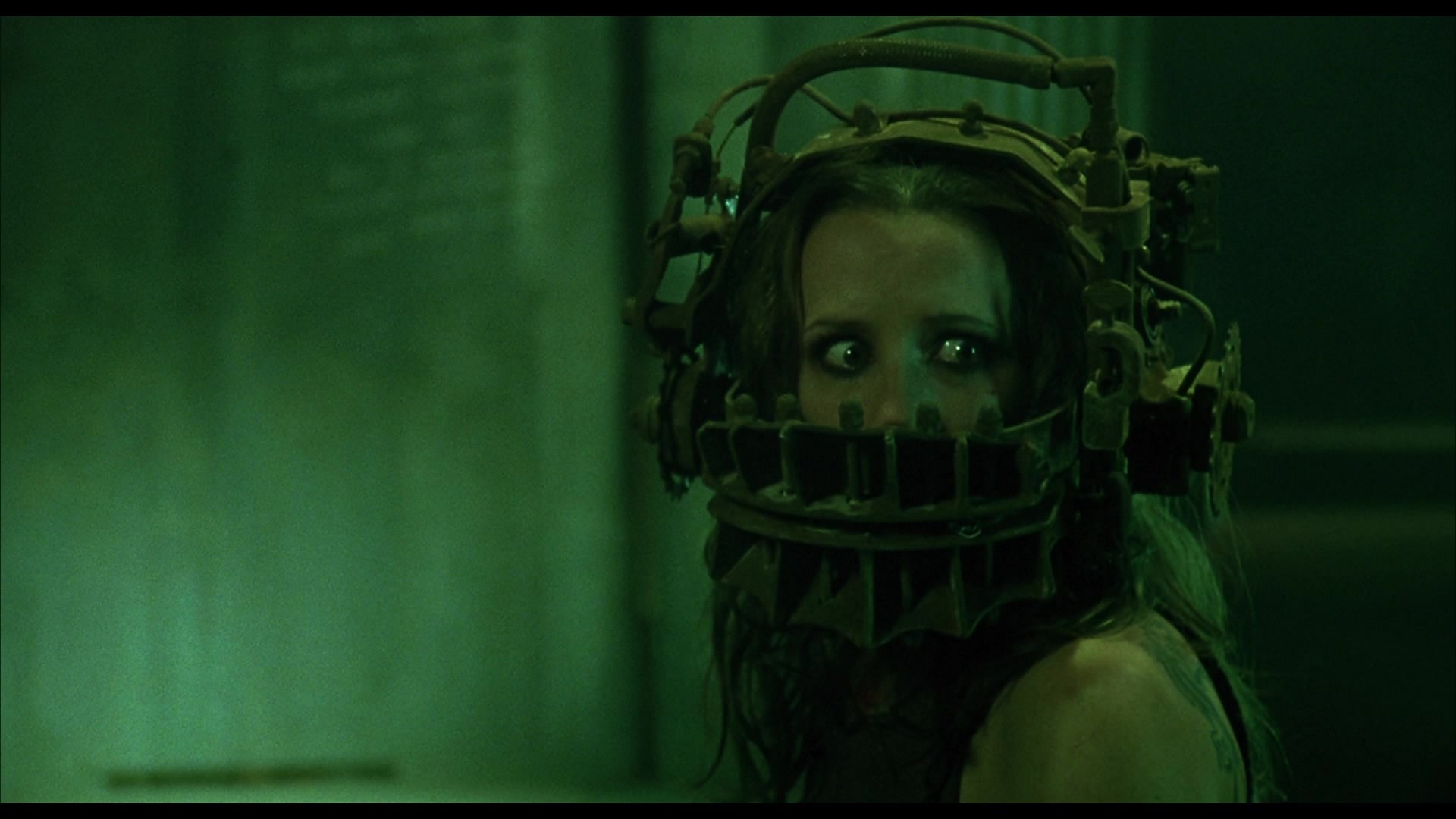
Saw is not torture porn. The same may not be said for its sequels but we’ll get to them. Saw is an elegant horror in that it generates tension with the anticipation of gore rather than gore itself. The flashback showing Amanda, one of Jigsaw’s victims, is the best example of this. Watching her struggle to remove the reverse bear trap, wondering if she’ll free herself before it goes off, is far worse than just witnessing the gory sight it would create.
However, suspense is not just used to hype up Jigsaw’s traps. Scenes involving the detectives chasing Jigsaw or Jigsaw capturing his victims produce good tension and jump scares.
The scenes beyond the room also do a good job of indicating Jigsaw’s genius. By the third act Gordon and Adam not only understand how they’re linked and why Jigsaw has chosen them but how far and wide Jigsaw’s game goes. After many, many cutaways, when you return to that room you know it’s not just these men’s lives at stake.
It’s been a while since I’ve binged all the Saw films. I can’t really rank them best to worst from memory but after this marathon, I’ll be surprised if I don’t put the original on the number 1 spot. We’ll have to see.
I give Saw a brutal 9 out of 10.
If there were less flashbacks, I might’ve given it a 10.
One down. Nine to go.
 Duffhood
Leave a reply to Round Two. Saw II (2005) Review – Duffhood Cancel reply