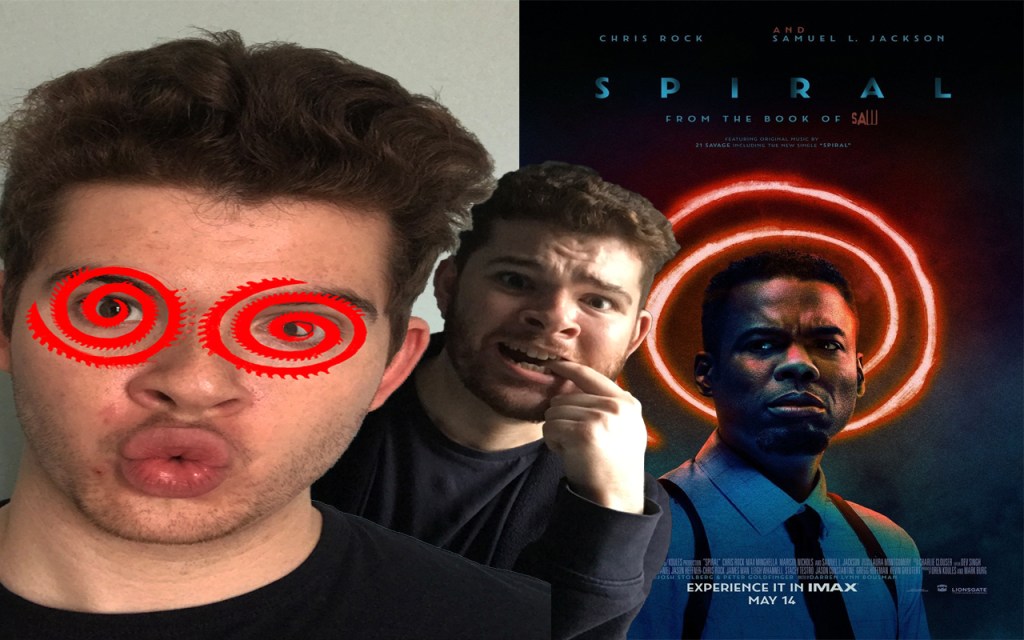
This is the second of what I call a re-review that I’ve posted on this blog. I’ll admit, I could come up with a better name but since it was 2015 when I first came up with it, refining the idea hasn’t been a priority.
Revisit? Reconsideration? Whatever, this is the second film after The Revenant that I’ve watched again specifically to reassess. I covered Spiral during its theatrical release and had a lot of bad things to say about it.
Reviewing it now with the context of eight film fresh in my mind is a very different proposition. I can see how Spiral tries to distinguish itself from the Saw films while at the same time making it known that it takes place in the same world as Saw.
I don’t want to waste time with formalities in this review so if you want details about the film’s plot and characters, read my original review. Here, instead of Characters and Horror, I’m going to break Spiral down to its Premise and Execution, talking about what it tries to achieve and whether or not it’s successful. Let’s dive in.
The Premise
If the first Saw was a horror film with a bit of police procedural in it then Spiral is a police procedural with a bit of horror. I appreciated this a lot more on the second watch. After eight films of people wandering around abandoned warehouses, it was such a relief to see Spiral take full advantage of its city setting. The trap scenes do occur in their closed-off interiors but when they’re not playing, we’re with Chris Rock cruising through an American metropolis.
In my original review, I praised the film’s use of comic relief. Again, I appreciated this so much more on the second watch. I don’t think there was a single joke in the entirety of the series between the first one and Jigsaw. It occurs in the banter between Rock and his fellow cops, which feels natural. It never dilutes the dramatic elements as comic relief can when injected into a horror.
The Jigsaw copycat we see in Spiral takes John Kramer’s Darwinian philosophy and applies it to the corrupt police officers in Rock’s department.
This is a really good idea for a Saw reboot. It doesn’t just necessarily enhance the police procedural aspect of the series but introduces contemporary but very compatible themes of corruption and police brutality. The traps become weapons against oppression. We hear the killer themselves ask why limit Jigsaw’s philosophy “to an individual when you can apply it to a whole system.”
I would’ve loved to see this approach explored in more films, which is extremely unlikely now considering the film’s box office performance and the existence of Saw X. However, I think it’d be fair to argue that Spiral’s execution of these ideas played a role in its failure.
The Execution
Spiral is terrible at dramatizing exposition. Detective Zeke (Rock) works in a police department with a long history of corruption that is complex but plausible. Unfortunately if it’s not explained in awful dialogue, it is revealed in brief small flashbacks that’re scattered throughout the first and second acts, not giving us a whole picture until just before the climax. I have a better idea of it now after the second watch but I was totally lost when I saw it the first time.
Zeke is a difficult protagonist to invest in. We know he started as an idealistic cop but became bitter after witnessing the greed and sloppiness demonstrated by his peers. His past is kinetic but his present is mostly stagnant. He’s an apathetic cop at the beginning and he doesn’t seem that different by the end, which, when he’s not being funny, makes him a pretty bland character.
Rock’s performance doesn’t help. What can I say? He’s a living cartoon. It’s hard to take him seriously when he sounds like how he sounds, even when he’s trying to be angry or intimidating. His star image overshadows the character he’s trying to channel.
Similarly can be said for Samuel L. Jackson’s character, who is Zeke’s father. Even if you can believe in his character beneath all his typical yelling and swearing, your faith will be destroyed when you see him don a 70s’ porn stache in the flashbacks. I thought he looked silly when I first saw him but seeing him again, I can’t help but see Steve Harvey. It’s a terrible look, someone in costume design should’ve said something.
I felt it a little when I first saw Spiral but it’s only after seeing eight Saws in a row that I realised how amazing it is to see the likes of Chris Rock and Samuel L. Jackson in a Saw film. It’s like watching Sandra Bullock in a Friday The 13th. It’s great to see that this level of talent would be interested in a franchise like Saw but in this case it seems that that very talent actually hindered the end product.
The voice of the killer sounds ridiculous. They sound like Natalie Wyn from ContraPoints, who’s a great content creator don’t get me wrong but her voice doesn’t exactly inspire dread. It’s clear that they were trying to go for something different from Tobin Bell’s gruffly speech, which is admirable but like the premise is executed poorly.
Spiral‘s dull but it’s not awful and is certainly not the worst Saw film. In fact, I’d say it’s the most ambitious entry in the series. Yes it failed in realizing its ambition but by trying to bring something new to such a worn-out formula, its effort is a lot more dignified than everything that’s come post Saw III.
I give Spiral: From The Book Of Saw a mediocre but respectful 6 out of 10.
 Duffhood
Leave a reply to Game Over. Saw X (2023) Review – Duffhood Cancel reply