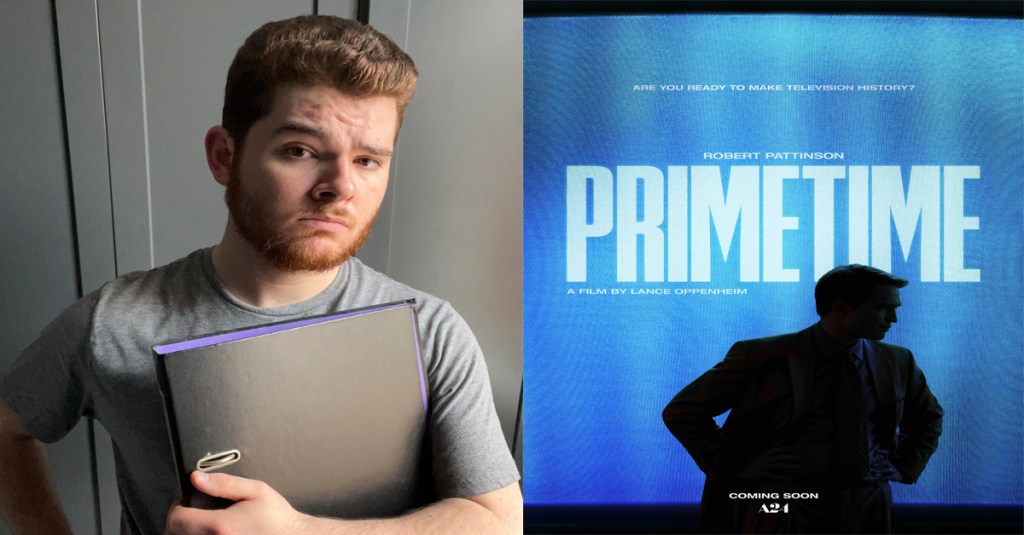
It’s not a Chris Hansen biopic. It’s definitely not a historically accurate telling of the rise and fall of To Catch A Predator. If you manage your expectations and go in with an open mind, you’ll embrace Primetime as the chilling Y2K horror it is. It’s a cautionary tale about how our age-old appetite for retribution manifests in the 21st century. The story takes place in the early-to-mid 2000s, but the issues it tackles are no less relevant in the late 2020s.
Inspired by true events, this psychological thriller follows TV reporter Chris Hansen (Robert Pattinson) and his team of producers and researchers as they make broadcast history with their show To Catch A Predator. To keep the show a success, the production team start to take risks and cut corners, triggering a series of events that eventually culminates in the show’s downfall.
Primetime takes the events and figures surrounding TCAP to tell an original story about the human cost of combining justice with entertainment. Hansen is cast as the villain, which, of course, isn’t true to reality, but it’s not supposed to be.
Hansen is a vampire, and the blood he hungers for is content. At no point does Primetime ask you to feel sorry for the predators Hansen confronts, but it criticises the attitude of entities behind stuff like TCAP without condemning investigations into child abusers altogether.
If Hansen is Dracula, then ‘Decoy Dan’ (Skyler Gisondo) is Jonathan Harker. Daniel is a young actor looking for his big break. He’s at that stage in his career where he can’t be picky; he has to take any acting job he can get.
When he first appears on the TCAP set as a decoy, he has no idea what he’s doing. Daniel knows there are hidden cameras and that the job involves some improvisational work. He only expects fellow actors to confront him, not potential criminals.
So when a predator arrives and exposes himself, Dan is horrified, but not for long. He gets used to being a decoy and begins to enjoy flexing his acting skills in each catch. That all changes when Dan sees his first catch broadcast on television.
He realises that his trauma has been commodified, just like the humiliation the predators experience. The horror Dan felt doesn’t matter compared to the bottom line, which for TCAP is ratings.
Now I think most people would agree with that assessment when it comes to 2000s’ reality TV; however, the attitudes and values on display in Primetime have not left us. They’ve just migrated to new spaces.
Anyone with an appetite for schadenfreude only has to look at their phone for influencers and podcasts to fulfil that need. Platforms hunt for individuals who they feel deserve dehumanisation, individuals that no one would feel sorry for.
Is there any wonder why TCAP was such a hit back in the day? Ask any mob who is more deserving of persecution than someone who would harm a child?
Primetime isn’t about To Catch A Predator. It uses the TCAP phenomenon to show how companies commodify suffering and how addictive it can be, both for consumers and producers. This was happening in 2004 and it’s still happening today.
I live in England, so To Catch A Predator was almost never on here, but, like most Brits I suspect, I watched snippets of it on YouTube all the time growing up. I understand why fans of the show will want to see Primetime, but they should know the film isn’t a traditional docudrama.
Approach it like any other standalone narrative film, and you’ll see it as the masterpiece it is.
I give Primetime a chilling 9 out of 10.


Leave a Reply