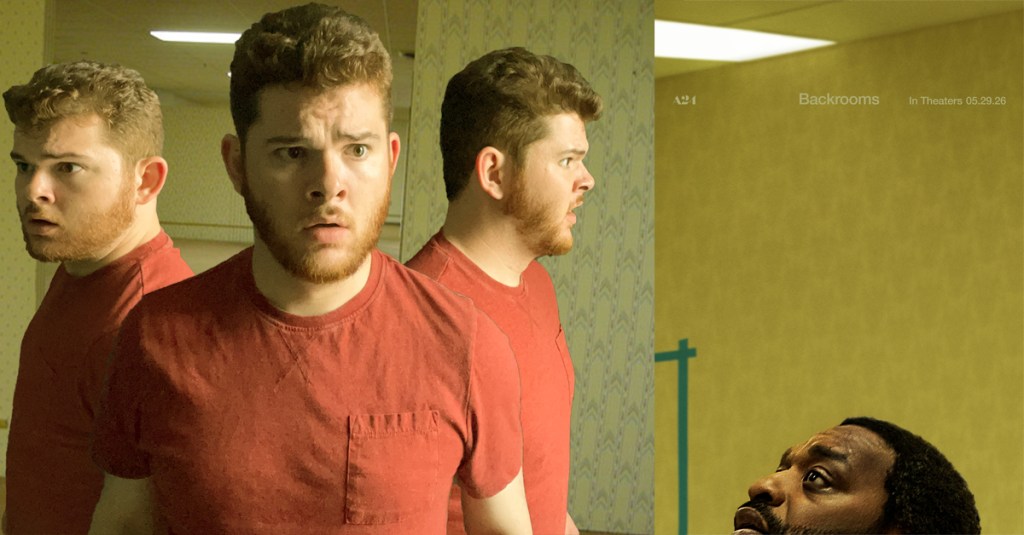
As a horror, Backrooms is a lot more complex than it has any right to be. Not only are the jump scares at a surprising minimum, but the film has the ability to get under your skin using ideas rather than atmosphere or imagery. Backrooms could be of that very rare breed of horror, the one that sticks with you.
Based on the web series created by Kane Parsons, this feature film adaptation centres on Clark (Chiwetel Ejiofor), a furniture salesman who discovers a portal to a strange labyrinth. He and his co-workers vanish while exploring the maze, prompting Clark’s therapist, Mary (Renate Reinsve), to investigate.
The Story
For the uninitiated, the joy of the Backrooms web series is the mystery. There is an overarching story, but it’s told out-of-order and with little context. Each episode is a piece of a puzzle, encouraging viewers to watch attentively and search for clues and Easter eggs.
Maintaining this level of intrigue may be achievable in a web series, but trying it in a feature film can be difficult.
Fortunately, the Backrooms film is a major success in this respect, mastering the almost impossible balancing act of telling a good cinematic narrative while keeping the mystery aspect intact. The story shows enough to satisfy your curiosity, but keeps enough in the shadows to leave you wanting more.
The film’s story works both as a continuation of the series and as a jumping-on point for non-fans.
Taking place in 1999, Clark is introduced to us as a working man at a turbulent point in his life. His wife has left him, he’s a failed architect, he’s living in his own store, and he’s drinking to cope. In his therapy sessions with Mary, we learn that Clark has developed a deep, underlying rage against his ex and recent misfortunes.
It’s rare for a horror film to have a protagonist who’s sympathetic and interesting. There are good reasons behind Clark’s bitterness, but his coping methods are destructive, both for himself and those around him.
When Clark discovers the backrooms, he is both disturbed and excited. This is where the story gets philosophical. As Clark and Mary explore this bizarre maze, each of them sees something different. Mary sees something that horrifies her, while Clark sees something he’s always wanted.
You’d never think it, but this horror film based on a YouTube series really gets inside your head.
The Horror
If I recall correctly, there is a maximum of four jump scares in Backrooms, which, for a mainstream horror film, is extraordinarily restrained.
Anyone who’s scared of liminal spaces, or even feels slightly uncomfortable about them, will find Backrooms to be a tense watch. The film perfectly replicates the suspense that makes the YouTube series so compelling: the anticipation of what the next room will look like and what’s going to be in it.
There’s also some genuinely terrifying imagery. Things that, when you first see them, you know are just wrong. You can’t help but stare and try to find what’s off about them.
How the film’s philosophy will affect viewers, I can’t really pin down. It’s just too subjective. Broadly speaking, I think the film’s about duality and what it’s like to see yourself mirrored by something.
It’s suggested that the backrooms replicate the real world, but poorly. For someone like Clark, who feels he has no control over his life, the backrooms are a means of regaining command of his destiny. I think a lot of people will relate to this. We see the backrooms through Mary’s eyes and witness all its deformities, yet we understand why people would prefer it over the modern world.
Needless to say, Backrooms has rewatch value in abundance. I have no doubt I’ll have different theories following my next viewing. Of course, I have to recommend it.
I give Backrooms a solid 9 out of 10.


Leave a Reply