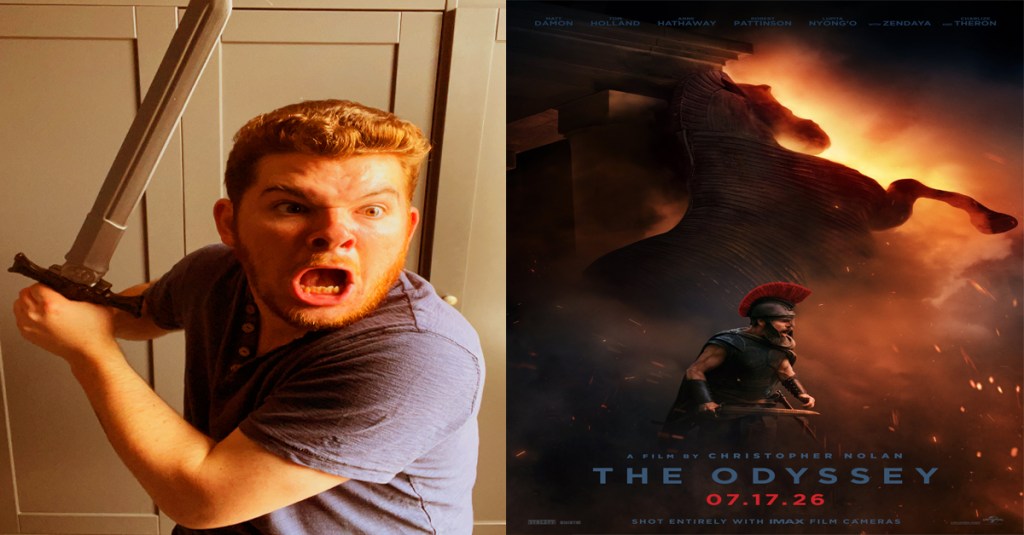
Every few years or so, there’s a blockbuster that everyone agrees is ‘pretty good.’ The Odyssey isn’t for everybody, but most people can look at it and will at least understand why it’s gotten so many rave reviews.
I liked the film’s grounded aesthetic and how it adapted Homer’s story in a way that’s contemporary and relevant to current issues. There are sequences I’ll be rewatching on YouTube in the not-too-distant future; however, I honestly don’t see myself rewatching The Odyssey in full ever again. I feel like I witnessed all its beauty the first time around, which I don’t think is a bad thing.
Based on Homer’s classic, The Odyssey concerns King Odysseus (Matt Damon), following his victory in the Trojan War, and his many futile attempts to get home. Meanwhile, his son (Tom Holland) and Queen (Anne Hathaway) struggle to protect his throne in his absence.
The Filmmaking
Nolan is no stranger to fantasy. Whether it’s Batman’s array of gadgets and vehicles or the ships and tech of Interstellar, his approach to fantasy has always been stripped-back. He seems to ask, ‘If this had to exist, right here, right now, what would it look like?’
The Odyssey is a big departure for Nolan in this respect because he isn’t rendering robots or Batmobiles. The fantasy of The Odyssey is alive with flesh and blood. Nolan’s grounded approach to the sword-and-sandal landscape of Homer makes for some of the best spectacle seen in years. In an age where CGI and green screen are everywhere, it’s wonderful to see a fantasy film where you ask yourself, ‘how did they do that?!’
The big showstopper is undoubtedly the cyclops sequence. It looks real. That’s all I can say.
The cinematography and sound design are also big highlights. Under Nolan’s direction, they both work in unison to create an immersive experience. I saw it on a big screen, not an IMAX screen, but a big screen, and I could feel the quaking steps of the cyclops and the violent waves of Poseidon. Even in a standard cinema, the film was able to rope me into its world.
The writing isn’t perfect. The first 20 minutes are a bit of a drag. There’s a lot of exposition and a ton of flashbacks setting up all the characters. I can imagine anyone unfamiliar with the story feeling a little lost during these scenes. Fortunately, further dialogue reminds you of who is who. By the end, you feel like you got more than the gist.
The runtime is a little too demanding in my view. In the last 20 minutes, I felt just like I was watching The Batman or Return Of The King; I’d be watching a scene, hoping it’d be the last, only to be treated to four more.
Cutting 20 or 30 minutes would make a big difference. Which 20-or-30 minutes? Hard to say, because as long as it is, it’s tricky to select a scene that serves no purpose. The screenplay is remarkably concise in that respect.
What’s The Angle?
Why tell this story now? I think that’s what every period piece or adaptation has to answer, especially with a story as common and influential as The Odyssey. What does this interpretation say to the people of the mid-2020s?
Well, I’m delighted to report that this film adaptation is extraordinarily relevant to our times and is far from another mere retelling.
The Odyssey is about Christian nationalism and imperial hubris. Odysseus is seen as a hero through many eyes except his own. As he journeys back home and exercises his might, he witnesses consequence. He and his men slaughter innocent people, lose battles and suffer the wrath of the gods. Odysseus realises that he, his kingdom and everything they represent are anything but heroic.
So he becomes lost, both literally and figuratively.
I think that’s how a lot of Western countries feel right now. Growing up, our governments and our media assured us that we were the good guys of the world. It was ok to invade certain territories because we were ‘liberating’ them, not conquering.
That was 25 years ago. Today, that narrative just doesn’t stack up. We have seen the consequences of our foreign policy, both domestically and overseas. Only the deluded among us can say we live in a ‘great country’ and mean it.
So what do we do?
The Odyssey argues that where we are today is because of decisions made by yesterday’s leaders, leaders who are still around and in power. The film shows that if anything is to get better, those leaders must ‘go into exile’ so that the leaders of today can take the helm.
This is powerful stuff considering how many policies with global ramifications are being passed today by leaders who’ll be long dead by the time those ramifications take effect.
If you don’t know Homer’s Odyssey, I’d recommend watching an educational breakdown on YouTube beforehand. There’s plenty of them out there. Beyond that, all I can say is believe the hype and go see it.
I give The Odyssey an epic 9 out of 10.


Leave a Reply